Overcall is a trustless platform for skill-based markets across crypto and stocks, priced by decentralized oracles and settled onchain. These docs cover how it works, end to end: the first product, Channels, the $OVER economy underneath it, and the engine everything runs on.
Overcall is a platform for a genuinely new class of market: trustless, skill-based, and built to be played. You trade the path of a price, not just its direction, across crypto and tokenized stocks, priced by real-time decentralized oracles and settled onchain. One engine powers every product, so the platform grows by adding markets, not by rebuilding trust each time.
The read is the edge. A neutral vault is always your counterparty, your multiplier is the honest inverse of your win probability, and every price, position and payout is a public onchain event. Channels is the first product on the engine; the same core carries whatever we ship next.
What Overcall stands for
The principles the platform and the engine are built around. None of them are slogans, each is enforced by the code, not by us.
Crypto + stocks
Majors and tokenized equities on one venue, priced and settled on the same rails.
Pioneering mechanics
You trade the path, not the direction. A skill game where a sharp read beats a big bag.
Social by design
Every position becomes a shareable result card, and you can back the traders you rate or fade the ones you don't.
Built on scalable rails
One engine, one vault, one $OVER. New products plug in, and liquidity pools once, not market by market.
Real-time prices
Sub-second decentralized oracle prices, the same number everyone settles on.
No order book
A neutral vault is always your counterparty, so any market exists the moment you draw it.
No house edge
Your multiplier is the true inverse of your win probability. The only margin is a published fee.
No custody
Funds live in onchain contracts, never on our books. We cannot touch them.
Always liquid
Open or close any position, any second, for a known amount. No opponent to wait for.
Fair by design
Prices, positions, payouts and rules are public code. You replay the chain instead of trusting us.
Highly entertaining
Fast, visual and genuinely fun to play. Reading a chart has never paid quite like this.
Built for humans and agents
Every action is a contract call plus a signed price report, so anything a wallet can do, a program can do.
Proven onchain
Every entry, settlement and payout is an onchain event, verifiable by anyone, forever.
One engine, every product
The hard parts, pricing, the vault, settlement, identity, and the token, live in the rails. A new product is a new front end on a proven core: one vault, one $OVER, one ledger, many products. A competitor starting from an order book has to solve liquidity market by market. Overcall solves it once, and every product pours volume into the same pool. See Platform engine for how the rails fit together.
About Overcall
Roadmap
Where the platform is and where it is going. Everything already shipped is checked; everything ahead is planned. Timeframes are directional, not commitments, and the plan evolves with the platform.
Pre-TGE
Live on the testnet today: the full engine, the terminal, both products, the dashboard, accounts and content. One item remains before the phase closes, the public opening.
Engine (rails)
Full smart-contract stack: separate contracts for the game logic, value custody, asset and model configuration, roles and timelocked upgrades, so every rule of the game is enforced onchain, not by us
Full-reserve vault: one contract custodies every deposit, settlement payout, creator royalty and protocol fee, and reserves each payout up front, so the platform can always pay what it owes
Onchain model registry: the pricing model is published and pinned onchain, so anyone can recompute their multiplier
Oracle-anchored entries: entries bind to signed Chainlink Data Streams reports, so no party picks your entry price
Autonomous operator: quoting, binding, liquidations and settlement run unattended around the clock
Live data pipeline: the price engine and indexer keep every client on one live feed and continuously verify the offchain view against the chain
GraphQL API: public reads and live subscriptions for the app and anyone building on it
AWS infrastructure: production co-located with the oracle origin, deployed as code on every merge
Testnet faucet: free $OVER so anyone can trade the full system end to end
Terminal
View modes: Focus auto-frames the action, Manual gives full navigation and drawing tools
Chart navigation: interval selector and zoom tools
Chart styles: line and candles
Positions panel: Channels and Prediction taxonomy with product filters
Asset selector: crypto and tokenized stocks, with filters
Watch: spectate any position live via shareable public /position and /prediction links
Themes: dark and light
Platform navigation: one-click dashboard access from anywhere in the app
Guided tour: interactive walkthrough of the whole interface
Wallet connect: injected wallet support
Products
Channels: draw your own channel on a live chart and back it to Survive or Breach; both sides priced from its survival probability
Channels Prediction: open a position on someone else's live channel, Survive or Breach, at the same probability-honest odds
Dashboard
Overview home: account and platform at a glance
Platform metrics: live platform stats, vault performance and the activity feed
User metrics: balances, open positions, history and activity
Leaderboard: skill ranking by net score
Settings: identity and preferences
Accounts & social
X connectivity: link an X profile and appear by handle across the platform
Wallet profiles: a shareable public profile for every wallet, with profile share cards
Share on X: position and prediction result cards rendered from real position geometry
Creator royalties: a channel earns its creator royalties from predictions taken on it
Access system: invite-code gate for the private testnet
Brand & content
Landing page: the platform story at overcall.io
Documentation: full product documentation, from quick start to contracts
Changelog: dated public development log
Milestone
Public testnet opening: the invite gate lifts and anyone can trade
TGE ↔ Mainnet
$OVER TGE: token generation event on Virtuals; $OVER is live on Robinhood Chain mainnet at 0x6245…3a4F
External audits: audit series covering the platform smart-contract architecture (Nethermind and/or others)
Airdrop campaign: launches with an ROI-based leaderboard
Staking on mainnet: stake $OVER to participate in the airdrop
Data Streams on mainnet: Chainlink Data Streams integration for Robinhood mainnet
Partnerships: first ecosystem partnerships and joint campaigns
Architecture iteration: continuous refinement from feedback and testing
Mainnet day
Crypto asset class live: the crypto asset class goes live on mainnet
Vault seeding: the vault is seeded with 15% of the $OVER supply
Staking rewards transformation: stake $OVER to back the vault and earn platform fees
Full stack on mainnet: all products and data pipelines live
Two environments: production and testnet run side by side, with testnet transitioning to demo mode
Post-mainnet (3-month horizon)
Airdrop distribution: the campaign's rewards are distributed
Multi-asset positions: open and settle positions spanning multiple assets
$OVER perps: a new market and a hedge for price risk during open platform positions
New platform product: built on the same rails
Stock asset class: the tokenized stock class launches on mainnet
Crypto expansion: the crypto class expands with more assets
Agent playbook: developer reference, API surface and quickstarts for AI agents
Agent integrations: first ecosystem agents trading on the platform
Community features: new features shipped on community demand
Longer durations: extended position duration bounds
Post-mainnet (6-month horizon)
Multichain: platform and token expand to Base
Asset expansion: 25+ crypto and stock assets in total
CEX listing: 1+ centralized exchange listing for $OVER
Fiat on-ramp: direct fiat funding integration
Next products: further platform products on the same engine
Post-mainnet (moving forward)
SOON
Further products and features land here as the platform grows on community demand.
Products · Channels
Channels: your walls, your rules
The first product on Overcall, and the fastest way to see what the platform does. You draw a channel on a live price and take a side: Survive if it holds every wall to the end, or Breach if a wall breaks first. Priced by a decentralized oracle, settled onchain, paid from the vault.
In a nutshell
ETHLIVEDRAWING WALLS×1.00
Draw the walls, pick a side, and the price plays out against them. Switch sides to see each outcome.
You draw an angled band of two walls on the live price of any market, then take a side and open a position in $OVER. You shape the channel with three controls, the angle it leans, the width of the walls, and the duration it runs. Those set one number, the probability your channel survives, and each side's multiplier is the honest inverse of its own outcome, final the moment your entry is bound to a signed price report.
Then it ends one of three ways: the channel holds to the end, which pays the Survive side in full; a wall breaks, which pays the Breach side and liquidates Survive; or you close early for a known amount. Whatever you collect is paid from the vault, and every step is an onchain event anyone can verify. The only difference with Prediction is whose channel you back: your own here, someone else's live one there.
From a connected wallet to your first payout. Prefer watching first? The full walkthrough video is on The terminal.
Get in.
The testnet is open to everyone, no invite code. Connect a wallet on Robinhood Chain (an Arbitrum-based L2). See Getting access and Contracts & addresses.
Fund your balance.
You play in $tOVER, the testnet twin of $OVER. Mint a free balance in one tap, repeatable, so you can start straight away; at mainnet the same flow runs on $OVER.
Pick a market and draw.
Choose any market, then drag on the chart to set your angle, width and duration. The ticket prices both sides of your channel before you commit. See The terminal.
Take a side, open.
Back your channel to Survive (it holds every wall to the end) or Breach (a wall breaks first). Your request goes onchain and your entry is bound to a signed price report, so nobody picks your entry price; your multiplier is final when it binds.
Close, get paid.
Survive collects the full multiplier if the channel holds to the end, and is liquidated at 0 if a wall is touched; that same touch pays Breach in full. Either side can close early for a known amount, and the vault pays you the instant it resolves.
Nothing to sign up for. There is no account and no custody. You connect a wallet, and every position and payout is an onchain event under your address. Connecting X is optional and only sets how you appear (see FAQ).
Three continuous knobs shape every position, the angle you lean, the width of your walls, and the duration you commit. Then you take a side, Survive or Breach, and its multiplier, the honest inverse of that outcome, is final the moment your entry is bound.
You enter at the bound mark: Survive wins if the price holds inside your walls to the end, Breach wins if a wall breaks first.
The channel you draw
A channel is a band on the live price with four parts: a center, a height (how far the walls sit from the center), a slope (the lean), and a start and end. The center either follows the line you draw, or is fixed by the entry price of the first position opened on it. The walls track the center as it leans:
You shape all three from the ticket: the angle (slope), the width (height), and the duration.
Angle, width, duration
Three continuous knobs shape the channel. Angle tilts it up or down, your read on the trend. Width sets how far the walls sit from the center, measured in range, the asset's volatility unit. Duration is how long it runs. Together they set one number, the probability your channel survives to the end, and that number prices both sides: tighter, steeper and longer are harder to survive, so Survive pays more and Breach pays less.
Your multiplier: the honest inverse of your side
The operator reads the asset's live volatility and the exact shape you drew and computes P, the probability the channel survives to the end. It is the chance a random price path with drift never touches either wall, a standard double-barrier model averaged over the uncertainty in volatility. Each side's multiplier is the honest inverse of its own outcome, less a published spread:
Multiplier
Survive: M = (1 − δ) / P Breach: M = (1 − δ) / (1 − P)
δ = the published spread on each side's odds, the model's buffer · both capped by a ceiling that keeps the vault solvent. The platform's income is its published fees, never a hidden edge. Rough anchor: a 25% survival call pays about 4× on Survive.
The spread δ sits next to the odds, never inside them (see Parameters & limits), and there is no hidden edge: anyone can recompute your multiplier from the signed inputs. The same P prices both sides of your channel, so you can take either. A channel exists as an NFT, and its creator earns a royalty whenever a prediction wins on it.
Your entry is bound, not chosen
Opening is a request, not an instant fill. Your deposit and signed quote go onchain, and the position becomes active only when it is bound to a signed price report that covers your timestamp. Nobody, neither you nor the operator, picks the entry price: it comes from the report. Your multiplier locks at that moment and nothing about the deal can change afterward. The open fee, the greater of 1% of the deposit and 0.5 $OVER, is carved out of the deposit at open, win or lose; the rest is your stake, the amount every payout formula multiplies. Then you decide how to leave: Closing a position.
Products · Channels
Closing a position
Your multiplier is final when your entry binds onchain. The side you took, and how and when you leave, decide how much of it you collect, and the vault settles you the instant it resolves.
The ways out
Exit
You collect
When
Your side wins
stake × M
Survive: the channel holds to the end · Breach: a wall breaks first
Close early
stake × M × Pwin × (1 − penalty)
either side cashes out before it resolves, for a known amount
Your side loses
0
Survive: a wall is touched, the position is liquidated · Breach: the channel holds to the end
Any payout above your stake carries the profit fee: 10% of the profit, published beside your odds, never inside them. 15% of that fee is paid to the channel's creator as a royalty; the rest is vault revenue. See Parameters & limits.
ETHLIVEHELD TO END, SURVIVE WINS×2.40
The same channel, three endings: hold to the end and Survive wins, close early for a known amount, or break a wall and Breach wins.
Hold to the end
If the channel reaches its end without touching a wall, the Survive side collects the full payout, stake × M, and the Breach side settles to 0. An end-of-channel settlement needs no price report at all, so it can never be blocked by an oracle outage: no report means no breach can be proven, which favors Survive. This is the never-stuck escape (see Platform engine).
Close early, mark-to-market
Change your mind at any second and cash out for a known amount. An early close is valued at your position's current win probability, then reduced by a small early-close penalty (5%):
Early close
value = stake × M × Pwin(now) payout = value × (1 − penalty)
Pwin is priced at the request moment, using the volatility your position was opened with. The terms of the deal never change retroactively.
For a Survive position Pwin is high while the price sits centered, and falls as it drifts toward a wall; for a Breach position it is the mirror, rising as the price closes in on a wall. The request to close is irreversible, and it settles by the close price and probability at that moment. If the price is already outside the channel when you request, that is a breach, not a close.
Touch a wall, and refunds
A wall touch resolves the whole channel at that instant: the Breach side collects its full payout, stake × M, and the Survive side is liquidated (0). The breach is proven, not decided: the operator submits the signed price report that crossed the wall and the contract verifies its signature onchain, so no breach can be fabricated. One proof settles every position and prediction on the channel, whichever side each took. Cancellations and refunds (an entry bound after a breach, a rule cancellation, or a settlement window that lapsed) return your deposit minus the fixed portion of the open fee (0.5 $OVER): that fixed portion covers the operator's gas; everything else comes back.
A wall is a real liquidation for Survive. One touch ends a Survive position at 0, like a futures liquidation, and pays the Breach side in full at the same moment. That is the tension: tighter walls pay Survive more but leave less room to be wrong, and that same touch is exactly what Breach is paid to call.
Products · Channels
Parameters & limits
Every knob and every limit in one place. Plain meaning first, exact values as they are finalized. These are set in the contract and enforced by the chain.
Knob / limit
Range
What it means
Angle
−2.5 … +2.5
trend lean (the channel's slope); steeper drifts faster toward a wall
Width
±0.5× … ±2.5× range
wall distance (the channel's height), in range; tighter is harder to survive
Duration
15m … 24h
position length; longer gives the price more time to reach a wall
Survival probability P
0 … 1
the model's chance the channel survives to the end; prices both sides
Spread δ
published
the platform's transparent margin, the same number for both sides (there is no hidden edge)
Ceiling
caps M
the maximum multiplier, which keeps the vault solvent
Minimum multiplier
floor on M
a side priced below it is cancelled, not offered
Open positions
unlimited
no cap on concurrent live positions per wallet
Exposure cap
global
full reserving: every position's max payout is reserved from vault capital
Open fee
max(1%, 0.5 $OVER)
carved out of the deposit at open, win or lose; the payout multiplies the rest
Profit fee
10% of profit
charged on any payout above the stake, published beside the odds
Creator royalty
15% of the profit fee
paid to the channel's creator on every winning position on their channel
Early-close penalty
5%
the discount on an early close's mark-to-market value
SOON
The remaining production numbers are being finalized for launch and will be published here: the spread δ, the multiplier ceiling and minimum, the position min and max, and the exposure caps.
Range: the volatility unit
Width and angle are measured in range, the typical size of a move for that asset, right now. It is what makes "±2× range wide" the same difficulty on BTC as on TSLA. The operator maintains range as a smoothed estimate that reacts to the current regime without jumping on a single spiky minute. Range only sizes your channel at open, and is frozen into your walls from there. It never decides who wins: the price against your walls does. It is the one bounded input the platform maintains, and it can only scale a channel, never move a wall after open.
Products · Channels
Markets
Crypto and tokenized stocks, all on the same rails and the same payout table. Because everything is measured in range, one channel is the same difficulty on BTC as on TSLA.
Crypto markets are open around the clock. Tokenized stocks follow their regular trading session; outside market hours a stock market pauses. Every market is priced by the same decentralized feed and settles under the same contract, so nothing about the rules changes when you switch assets, only the volatility unit (range) does. New markets can be added without new rules, because any market the oracle can price, the vault can take.
Products · Channels Prediction
Predict on any live channel
Every open channel is a two-sided market. Take a view on someone else's call: back it to Survive, or back a wall to Breach. Both sides are priced in the open from the channel's own survival probability.
Survive
Back the channel to hold
Survive pays if the channel keeps every wall to the very end. You are backing the caller's read.
Breach
Back a wall to break
Breach pays if a wall gets hit before the end. One channel, two sides, priced in the open.
BTCLIVESOMEONE ELSE’S CHANNELP 62%
ONE SURVIVAL PROBABILITY PRICES BOTH SIDES
SURVIVE×1.58
BREACH×2.58
The price drifts toward a wall and P falls, so Survive pays more and Breach pays less, live.
That is the whole idea. For the odds, see Odds; for how a prediction resolves and closes, see Settling. To find channels to back, see Watch & spectate.
Products · Channels Prediction
Prediction odds
Both sides of a live channel are priced from one number, so they can never drift apart or be arbitraged against each other.
One probability, both sides
A live channel already has a survival probability P, the same number that priced the position on it. Prediction turns that into a two-sided market, each side the honest inverse of its own outcome, less the published spread:
Prediction odds
Survive = (1 − δ) / P Breach = (1 − δ) / (1 − P)
δ = the published spread · both capped by a ceiling · a side priced below the minimum is not offered.
The odds move as it plays
Entry odds on a running channel price the time it has already survived and steepen with the distance to the nearest wall: a nearly-finished call pays the Survive side less, and a channel drifting toward a wall pays the Survive side more. Whatever you take is final when your entry binds onchain, and recomputable by anyone from the signed inputs (see Platform engine).
Products · Channels Prediction
Settling & closing
A prediction resolves with the channel it backs, and you can leave early for a known amount, just like a position.
Exit
You collect
When
Your side wins
stake × odds
Survive: every wall holds to the end · Breach: a wall breaks first
Close early
mark-to-market × (1 − penalty)
you cash out before it resolves, for a known amount
Your side loses
0
the channel resolves the other way
How it settles
If the price touches a wall before the end, Breach wins and Survive is out, from the same signed proof that liquidates the channel. If it holds to the end, Survive wins. The channel's creator earns a royalty on every winning prediction inside it: 15% of the prediction's profit fee. Draw a channel others want to trade, and it pays you beyond your own ride.
Close early
You do not have to wait for the end. Close a prediction any time for a mark-to-market amount set by its current win probability, less the early-close penalty, the same way a position closes.
Watch, then predict. Any position has a public watch link that renders the live channel on the real chart, no wallet needed, and the prediction ticket sits right there. See Watch & spectate.
Using the app
The terminal
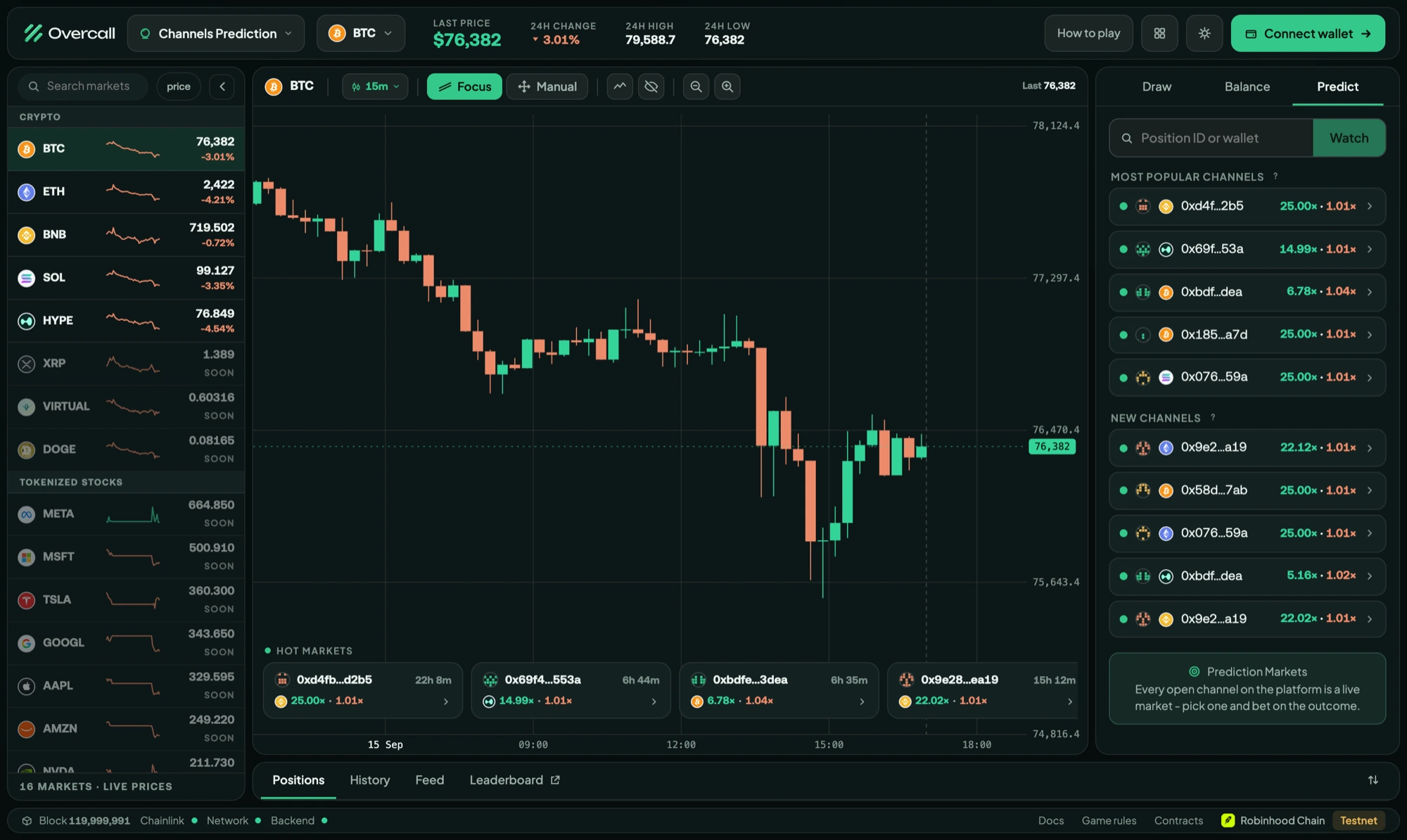
Where you draw and trade: a live price chart, the channel you shape on it, and a ticket that prices your position before you commit.
The terminal, end to end: markets on the left, your channel on the chart, the ticket pricing it live.
The chart
Japanese candles by default, or a line. You draw your channel directly on it, dragging the tilt grip to set the angle, the wall grips to set the width, and the end grip to set the duration. The eye toggle hides or shows the drawn channel, and a position can never be opened while it is hidden.
Focus and Manual
Focus auto-frames and tracks your channel so the drawn shape always stays in view (the default on mobile). Manual hands you the wheel: free pan, zoom, scrollback and a price-axis drag (the default on desktop). Switch any time from the chart toolbar; a double-click or an interval change returns the same default frame in either mode.
Drawing tools
In Manual mode a full drawing toolkit is available: trendlines, rays, horizontal and vertical lines, rectangles, Fibonacci, a freehand brush, text and a measure tool, with magnet snap and a color picker. Your drawings save per market and sync to your wallet, so they follow you across devices.
Market rail
Every market runs down the left, grouped into crypto and tokenized stocks, each with a live price, 24h change and a sparkline. Search or sort them, spot a dot on any market where you hold a live position, and a CLOSED tag on a stock outside its session. See Markets.
The ticket
The ticket carries the three sliders (angle, width, duration), the side you take (Survive or Breach, each with its own live multiplier), your position size with quick presets, and a payout card that shows the estimated multiplier, the full payout and the fees before you open. Fund it from the Balance tab (see Quick start). Once open, the position plays out on the chart, and you can review any past run in place.
Every position is watchable, live, by anyone, no wallet needed. Watch a channel play out on the real chart, then take a view on it.
The Predict tab lives in the right rail: pick a channel or an open position and it renders live on the chart.
Watch anything
Open the Watch & Predict tab to browse the top players and the top open positions, or search a specific position by ID or a whole wallet. Picking one renders that live channel on the real chart with its full stats: side, entry, angle, width, multiplier, current value, and progress to the end.
Watch, then predict
From any watched channel you can open a prediction right there, backing it to Survive or Breach. Watching a player's wallet shows their live positions and their standing, and links through to their full profile.
Links that unfurl
Every position has a public watch link (for example /channels/watch/<asset>/position/<id>) that renders the live channel with no wallet, and unfurls a branded card when shared on X, Telegram or Discord. Add ?embed=1 for a chrome-less version to embed anywhere. To share your own results, see Dashboard & metrics.
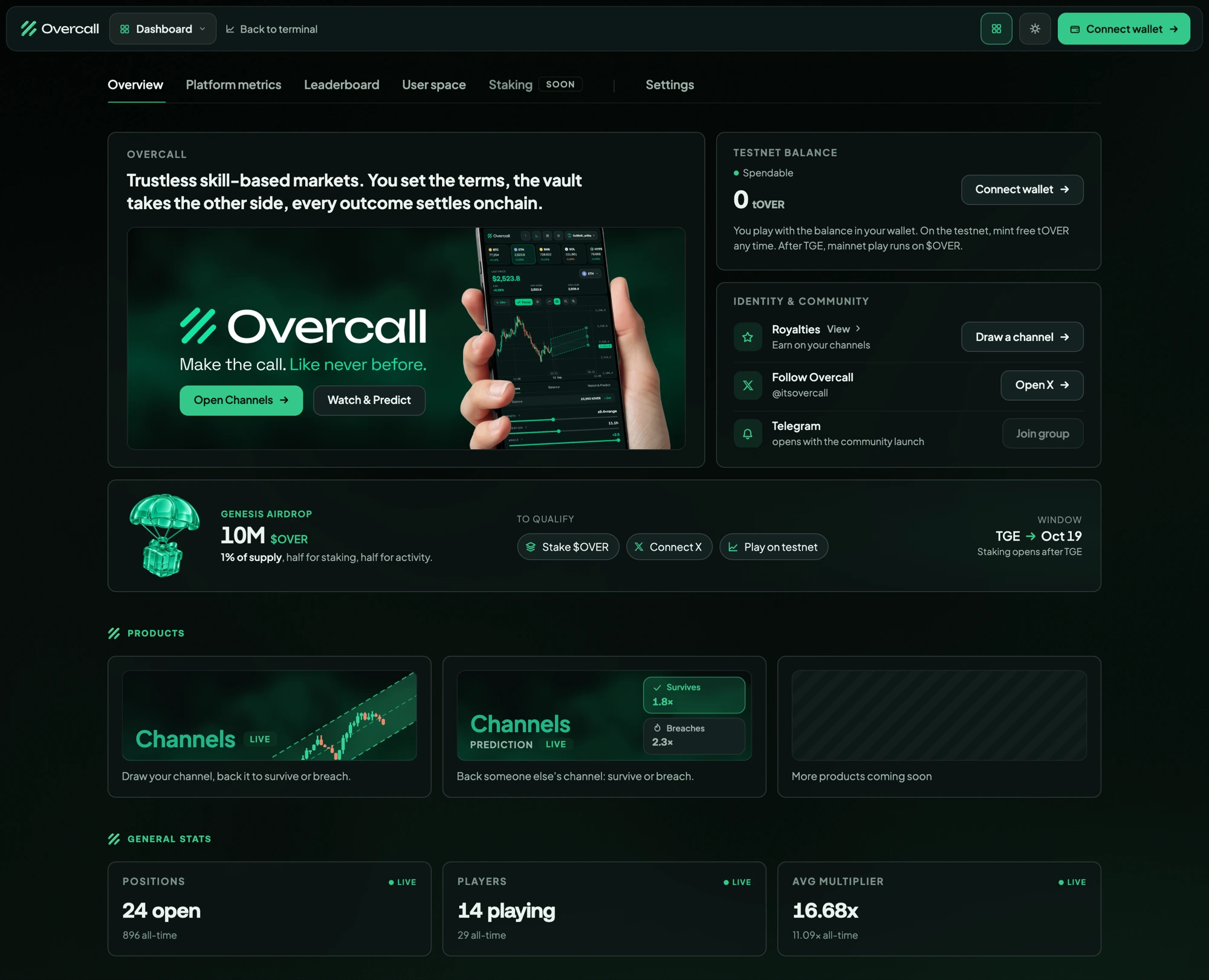
Everything about your account and the platform in one place. Open it from the grid button in the top bar.
The dashboard: your account and the platform side by side, every number backed by an onchain event.
Your account
The Overview shows your balance, identity and quick actions. User metrics is your full profile: your standing and rank, your active and past positions (each expandable to its onchain transaction trail and a mini price chart), a performance equity curve, and your activity. Any wallet is a public profile at /profile/<address>.
Platform metrics
Platform metrics is the whole venue at a glance: KPIs with sparklines (players, positions, average multiplier, most-popular market), the vault (balance, volume, open exposure, positions settled) with time-series charts, the biggest top wins, the top players, and a live feed.
Leaderboard and scoring
The Leaderboard ranks players by net score, your position PnL plus the royalties you have earned, the platform's skill metric. Filter by period, asset and product, and watch any ranked player's live position. A Staking tab is on its way (see Staking).
Identity and settings
Connect X to set your handle and avatar across the leaderboard, feed and share cards, and choose in Settings how you appear (wallet or X handle), your default dashboard tab, the chart style, and whether to replay the guided tour. Connecting is optional and only affects how you appear, never your ability to play (see FAQ).
How you show up across Overcall. Connecting an identity is optional and only changes how you appear, never your ability to play.
Connect X
Link your X account to set your handle and avatar everywhere they appear: the leaderboard, the activity feed, watch views and your share cards. It is a read-only connection for display, and you can disconnect any time. Playing never requires it.
Preferred identity
In Settings you choose how you are shown: your wallet, your X name, or your X handle. The choice applies platform-wide from one place, and falls back to a short wallet address if you have not connected X.
Public profiles
Every wallet is a public profile at /profile/<address>: standing and rank, positions and history, and a performance curve, all read straight from the chain. Anyone can open yours, and you can open anyone's from the leaderboard or the feed. See Dashboard & metrics.
Every result and every profile is shareable, and the links carry your identity and bring people in.
Share cards
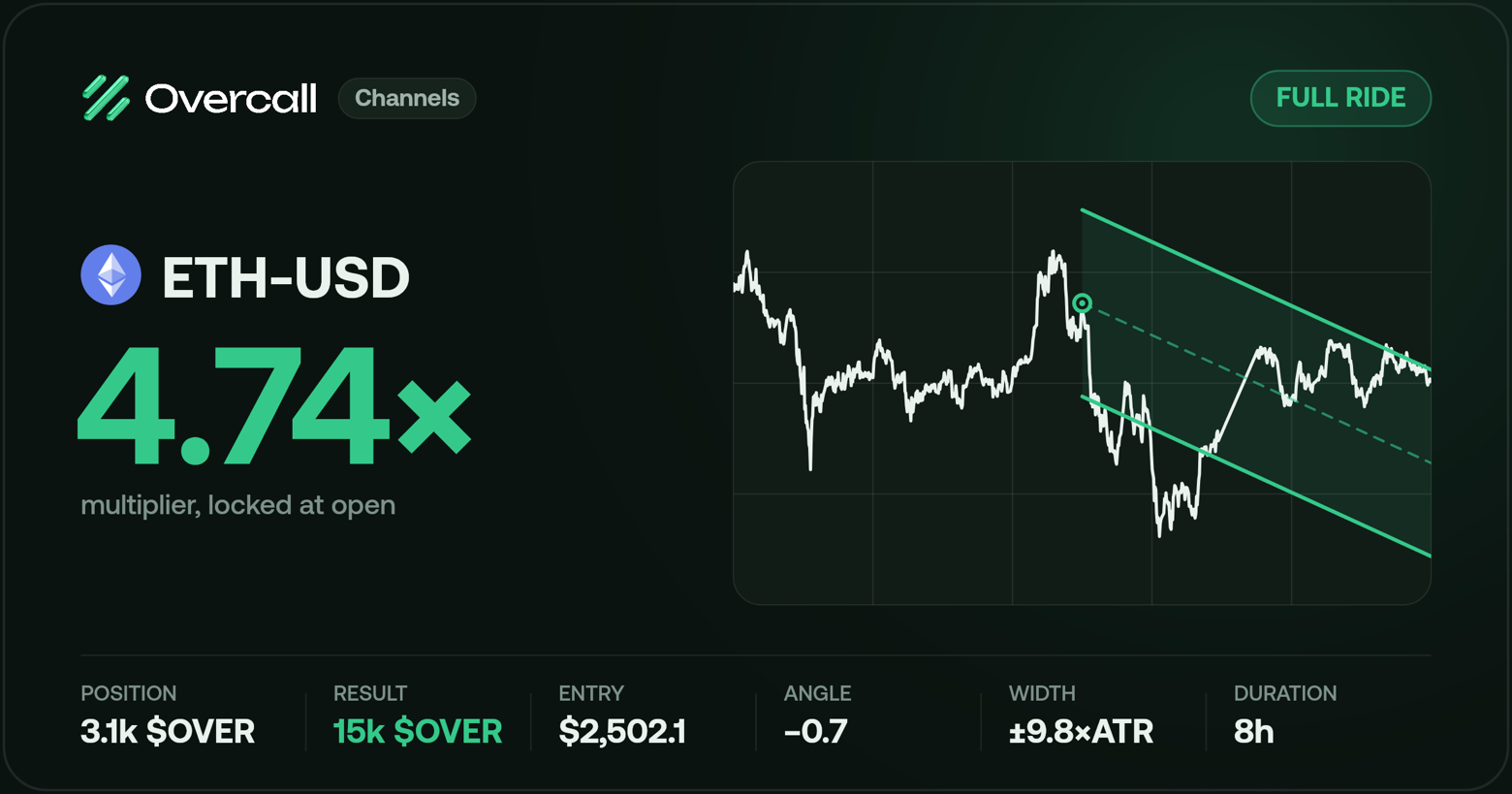
Any position becomes a branded result card that draws your real channel and its outcome (a win, an early close, or a loss, for whichever side you took, Survive or Breach), and your profile has its own profile card (rank, realized P&L, top assets). Both unfurl automatically when the link is posted on X, Telegram or Discord, and from the app you can post, copy the image, or copy the link.
A real result card, rendered by the platform itself, exactly as it unfurls on X.
Watch links
Each shared position is a live watch link: it renders the real channel on the real chart with no wallet needed, and an ?embed=1 variant drops the chrome so it embeds anywhere.
Referrals
Your invite link carries a referral tag. When someone connects through it they are attributed to you, and your invite count shows in the dashboard.
SOON
Whether referrals carry a reward, and how it is credited, is being finalized and will be published here.
The testnet is public: Overcall is open to everyone, no invite code. Connect a wallet, mint a free balance, and play the full system end to end while the platform is proven in the open.
Open to everyone
There is no gate and no allowlist. Open the app, connect any wallet, and you are in. Everything runs on free testnet $OVER, so you can trade every product before mainnet at no cost, and the whole system, prices, positions and payouts, settles onchain exactly as it will on launch.
How to play, and the guided tour
A short How to play explainer opens on your first visit, and a guided tour walks the terminal step by step, from the chart and the knobs to a live demo position and a prediction. Replay either from Settings any time.
Then fund and go. Mint a testnet balance and open your first position. See the Quick start guide.
$OVER is the single asset the whole platform runs on. Every position, on every product, opens and settles in $OVER, straight from the vault. The platform and the token are not two things that share a name: they are one system, and they grow together by design.
That design is a loop. More volume deepens the vault, a deeper vault clears bigger payouts and more volume, and platform fees route back into liquidity, so real revenue becomes deeper payouts. You play in $OVER and win $OVER, and the vault that settles your wins holds it too.
The flywheel
Positions Every position players open is volume through the engine.
Fees A transparent fee on that volume, the platform's real revenue.
Vault Fees deepen the neutral counterparty that settles every win.
Liquidity Fees also feed $OVER trading liquidity, tightening the market.
Fees deepen the vault and trading liquidity; the token and the platform lift each other.
The loop
more volume → deeper vault → higher payout capacity → greater holder rewards → more volume
Aligned by the vault's transparent fee, which keeps it net positive over volume, so growth funds itself.
Sustainable, not a subsidy. Over volume the published fee keeps the vault net positive, so the loop funds itself, with no treasury drain and no inflationary emissions behind it. See Vault architecture for how the counterparty is built, and Utility for what the token does.
Launch
$OVER launches on the Virtuals launchpad: liquid and community-owned from the token generation event, and the core financial asset of the ecosystem from day one. Channels is the first product, not the last, and future products plug straight into the same rails: one settlement engine, one identity, one $OVER economy.
The full supply and allocation, with every cliff and vesting schedule, are published on the Tokenomics page. The fee split is finalized before the token generation event.
Economy · The $OVER token
Tokenomics
$OVER is the central economic engine of the whole Overcall suite, not a standalone token. Every product, live or future, opens and settles in it, so as the platform scales, utility and value accrue straight back into the token. The design prioritizes sustained long-term utility over short-term speculation. The full breakdown is below.
Supply and allocation
A fixed total supply of 1,000,000,000 $OVER (1B), split across four top-level allocations.
Allocation
Share
Role
Protocol (automated capital formation)
25%
Core protocol liquidity mechanics.
Team
25%
Strict 12-month cliff, then 6-month linear vesting. Nothing releases at launch.
Liquidity pool (float)
20%
Initial floating liquidity at launch.
Pre-buy allocation
30%
Strategic protocol buckets acquired on the bonding curve. Unlocks no earlier than one month after the TGE (detailed below).
No day-one sell pressure, no emissions. No team tokens release at launch, held behind a strict 12-month cliff, and the pre-buy buckets begin unlocking no earlier than one month post-TGE. The loop is funded by a transparent, published fee, never inflationary emissions. See the flywheel.
Pre-buy allocation
To fund protocol security, expansion, and mainnet execution, 30% of supply was acquired via the bonding curve into strategic protocol buckets, keeping the platform self-sufficient and operational. Each bucket unlocks on its own schedule, the earliest no sooner than one month after the TGE.
Bucket
Share
Unlock
Settlement Vault liquidity Seeds and runs the Settlement Vault at mainnet, secured by a time lock.
Testnet airdrop Early community testers and power users from the testnet phases. See Staking.
1%
1-month cliff
The 15% Vault unlock, in the open
The 15% Settlement Vault liquidity unlocks about one month after the TGE, and that timing coincides with the mainnet transition by design. This is not market float or team sell pressure. 100% of it goes directly into seeding and running the Settlement Vault, secured by a time lock, giving the protocol the capital depth to clear live positions, process payouts seamlessly, and scale position sizes from day one on mainnet. See Vault architecture for how the counterparty is sized.
Staking and the airdrop
Staking goes live immediately at the TGE. Across the roughly one-month window to mainnet it powers the Genesis airdrop, the 1% testnet allocation split 50/50 between a stakers pool and a testnet-activity pool. On mainnet, stakers directly back the Settlement Vault and share in real protocol revenue generated by platform volume. Full detail, pools, eligibility, and reward tracks, is on Staking.
SOON
Fee split. How the platform fee routes between vault liquidity, trading liquidity, and stakers, published before the token generation event.
Economy · The $OVER token
Utility
What $OVER actually does. One asset, three jobs, all reinforcing the same economy.
Play
The currency of every product
Every position, on every product, is opened and paid in $OVER, straight from the vault. The more Overcall is played, the more $OVER has to be held and moved, so demand scales with real usage, not a narrative.
Back
Collateral in the vault
The vault that pays your wins holds $OVER, so the token directly backs settlement. A stronger token means deeper payouts. See Vault architecture.
Stake
Earn a share of fees
Stake $OVER to provide the vault's settlement liquidity and earn a share of platform fees. Your stake backs the payouts and shares in the upside. See Staking.
A demand engine and a supply sink
The same design pushes demand up and free float down. Usage forces $OVER to be held and moved, while $OVER locked in the vault (the genesis seed and growing with price) and $OVER staked to back settlement are out of circulation. Real activity raises demand while the circulating supply trends lower.
Economy
Vault architecture
At the center of Overcall sits one contract: the Settlement Vault. It is the counterparty to every position, on every market, instantly. That single choice is what makes Overcall always-liquid, and it is designed to scale in proportion with $OVER, both ways.
You do not trade against a house that profits when you lose. You trade against a neutral, onchain vault that takes the other side of every position and pays every winner automatically. There is no order book to bootstrap and no depth to run out of: if the oracle can price a market, the vault can take it, at the live mark, for a known amount. Its only margin is a published fee beside your odds, never a number baked into them. Anyone can read the rules, and anyone can recompute the result.
Onchain ledgerLIVE
MarketPositionResultPayout
Every row is a public onchain event: the vault pays, collects and balances in the open.
Scales with the token, both ways
A counterparty that can lose is only as strong as its balance sheet. At mainnet launch the vault is seeded with 15% of total $OVER supply, all in $OVER. Because every payout is denominated in $OVER, a higher token price means a deeper vault, which clears bigger max payouts and more volume, which lifts the token again. Platform fees route back into vault and trading liquidity, so real revenue becomes deeper payouts. You are not trading against a fixed pot a good day can drain, but a counterparty that gets stronger exactly as the platform does.
Sustainable, not a subsidy. The published fee is a small, transparent edge on every position. Over volume it keeps the vault net positive, so growth funds itself instead of draining a treasury, and no inflationary emissions prop it up.
Solvency is enforced, not promised
The vault is deliberately loss-bearing: over any short window, players can win more than they stake. It stays solvent by construction, not by discretion:
The odds are the honest inverse of probability, so aggressive positions are negative on average and the neutral edge is the published fee.
A per-position cap (the multiplier ceiling) and a global exposure cap, with every position's max reward fully reserved from capital, bound how much the vault can owe at once, so no single win can sink it.
Every one of these limits is onchain and public. You can read what the vault can owe, and recompute it.
This is the same shape as a perp DEX's LP pool: a real counterparty, sized by rules anyone can read, not a house that sets your price.
Cash-model settlement
The vault reserves the full gross reward for every open position. On a win, capital pays that gross amount, and the profit fee and the channel creator's royalty return as cash into the revenue and royalty buckets, so the books balance exactly on every settlement: deposit + fromCapital == player + revenue + royalty, to the wei. Nothing is netted out of sight, each settlement is a public identity you can check.
SOON
The concrete numbers are being finalized and will be published here: the fee routing split (vault liquidity vs trading liquidity), the exact exposure limits, and how staked $OVER (see Staking) tops up settlement liquidity, together with a vault-flow diagram.
Economy
Staking
Staking runs in two phases: first it powers the Genesis airdrop across the launch window, then on mainnet it backs the vault and earns a share of platform fees.
The airdrop window
For about a month, from the token generation event to mainnet, staking is how you qualify for the Genesis airdrop, 1% of supply shared between two pools. Stake real $OVER on mainnet to earn the stakers pool, and keep trading on the testnet in $tOVER to earn the testnet activity pool. One stake keeps you qualified for the whole window, even if you unstake before it ends. Staking is non-custodial with instant unstake, and your principal is never at risk. Rewards distribute after mainnet launch.
Pool one
Stakers
Your share scales with how much mainnet $OVER you stake and how long you keep it staked.
Pool two
Testnet activity
Your share scales with your testnet performance and how many positions you open through the window.
Staking on mainnet
When mainnet goes live, staking takes on its permanent role. Your $OVER joins the pool the vault settles from, so a busier platform pays stakers more, and staked $OVER is out of circulation, a supply sink. Staking is how holders turn real platform revenue into yield, without making you the counterparty to any single trade.
SOON
Exact values are being finalized. The airdrop's pool split and reward formulas, and, for mainnet, the reward rate and fee share, lock and unlock terms, and how staked $OVER tops up settlement liquidity. This page states the intent; the exact mechanism follows the staking contract.
Trust & tech
Platform engine
Underneath every Overcall product is one engine: onchain rails where positions and prices both live on the chain, a neutral vault as your counterparty, and a payout that is the honest inverse of your win probability. Channels is the first product on it; everything we ship next plugs into the same three pieces.
Onchain rails
Position and price, both onchain
Every position, close and payout is an onchain event anyone can replay, and the price is a decentralized oracle report, not a number we choose. Nothing sits behind a curtain.
Counterparty
A neutral vault, always
One vault takes the other side of every position instantly, so any market can exist and stay liquid. Details in Vault architecture.
Odds
Priced by probability
One survival probability prices both sides of a channel. Each multiplier is the honest inverse of its own outcome, locked at bind and recomputable by anyone.
Winnings priced by probability, in the open
Odds are where most platforms bury their edge. Overcall prices a position from one number, the probability it wins, read from live volatility and the shape drawn. The multiplier is the honest inverse of that probability, less a published spread that sits beside the odds and never inside them. A ceiling caps the multiplier so the vault stays solvent. There is no house edge hidden in the odds: anyone can recompute a multiplier from the signed inputs. On a normal book you learn the real odds after you lose; here you see them first. The same probability also prices a channel's two-sided prediction market.
Request, bind, settle
Opening is a request: your deposit and a signed quote (the volatility and the model version) go onchain. The position becomes active only when the operator binds it to a signed price report that covers your timestamp, which sets your entry price and locks your multiplier. Nobody, neither you nor the operator, chooses the entry. From there the price is read only against the levels fixed at bind. A close submits a fresh signed report and the contract computes your mark-to-market payout; holding to the end needs no report at all, so an oracle outage can never trap funds. A breach is proven by the operator's signed report in its next batch, so the vault is always made whole.
Because every input is either signed or onchain, any result is reproducible. The model's parameters are pinned by a hash in an onchain registry, so anyone can download them and recompute a multiplier from the quote, the report and the shape, and get the exact number the contract used.
Volatility only sizes, it never decides. Each asset's volatility (range) sizes the channel to its market and arrives inside the signed quote. It is bounded and never decides who wins; the price against the levels you set does. Everything else is either your choice or a signed oracle report.
The price layer, the decentralized oracle that settles everything, is covered in Price feeds.
Trust & tech
Price feeds
Every outcome on Overcall is decided by a decentralized price feed, Chainlink Data Streams, not by us. No single venue sets your price, so no one can paint a wick or hunt a stop to take you out.
Decentralized
No single-venue manipulation
Reports are aggregated across venues and signed by a decentralized oracle network, using multi-source reference prices rather than any one exchange's book. There is no single wick that can stop you out.
Sub-second
Fast enough to settle live
Reports are high-frequency and low-latency, so a close is marked to the market you are actually watching, not a slow, averaged feed.
A pull oracle, verified onchain
Data Streams is a pull oracle. Signed price reports are fetched off the chain and submitted with the transaction that needs them, and an onchain verifier checks the oracle network's signature before the contract uses the number. We relay reports to your browser for convenience, but we cannot alter them: they are oracle-signed. We never produce the price; we only read it.
No report, no problem. A channel that reaches its end settles with no price report at all, so a feed outage can never trap your funds or knock you out. See Platform engine.
SOON
The operational specifics, the feed identifiers per market, the report cadence, the onchain verifier address, and how the equities feeds behave outside market hours, will be published here as the rebuilt engine ships.
Trust & tech
Security & audits
The whole pitch is that you do not have to trust us. Here is what backs that up, and where the real risks are, named outright.
Never stuck
Funds cannot be trapped
A channel that reaches its end settles with no oracle report, so an outage cannot freeze your position. Liquidations are prompt: the operator publishes breach proof in its next batch, so the vault is never left holding a losing position.
No custody
Only your position is at stake
Only the position you open is ever at risk. The rest of your $OVER balance stays yours, and no operator can seize it or your winnings. It is all onchain.
Roles, disclosed
What admin can and cannot do
Admin can tune knobs within hard-coded bounds (fees, caps, curves) and rotate the keeper. Admin cannot touch the price, pick a winner, or seize your balance.
Public math
Recompute every result
The payout math, the caps and the settlement rules are in a contract anyone can read, and every result is an onchain event you can recompute from public data.
SOON
Formal audit in preparation. The independent audit report, its scope and fixes, the auditor and date, and a responsible-disclosure contact will be published here. Until then, treat the security properties above as claims you can verify against the code, not a third-party attestation.
Residual risks, stated plainly. Prompt liquidation depends on the operator publishing breach proof in its next batch; if the operator goes dark, your fallback is reclaiming your deposit after a bounded settlement window. The vault is a loss-bearing counterparty, sized by caps so no single win can sink it, but it can draw down. Range is an operator-maintained input, bounded and sizing-only, but it is the one input the platform maintains.
Trust & tech
Contracts & addresses
Everything on Overcall is an onchain event. This is where you verify it yourself, on both networks.
The $OVER token is live on mainnet (Robinhood Chain), with a block-explorer link above. The testnet addresses are live too, each with an explorer link and an add-network helper. The remaining mainnet addresses publish here as the rebuilt engine ships to mainnet. Every contract opens its exact code, its live parameters, and every position and payout ever settled.
Nothing about the rules is off-chain. Each contract link will open the exact code, the live parameters, and every position and payout ever settled. If a number matters to a result, it is onchain.
Trust & tech
Developers & agents
Overcall is built for humans and AI agents alike. Everything a wallet can do, a program can do, because the rules are a contract and the data is onchain events and signed reports. There is no proprietary API between you and the chain.
Trade
Straight to the contract
Open and close positions by calling the engine directly from your wallet; the operator brings the signed price report that binds your entry. The ABI is all you need.
Read
Live GraphQL, no key
Prices, the activity feed and vault stats are served by a public GraphQL API, queries and live subscriptions, no key. Query it, or read the events directly from the chain and recompute anything yourself.
Reproduce
Recompute any result
Download the model file pinned by its onchain hash and recompute any multiplier from the signed quote, report and shape. Every result is verifiable, not trusted.
Because the odds, a position's terms and the payout math are all onchain and deterministic, an agent can price a position, decide, and settle without trusting any intermediary. The model parameters are pinned by a hash onchain, so an agent can recompute any multiplier from the signed quote and report and check it against the contract.
SOON
Developer reference in preparation. Coming here: the ABI, the GraphQL API, a quickstart, and example agents. Reach out on X in the meantime.
Resources
FAQ
The questions worth asking, answered straight.
What can I trade?
Crypto (BTC, ETH, BNB, SOL, XRP, HYPE, VIRTUAL, DOGE) and tokenized stocks (NVDA, AAPL, MSFT, GOOGL, AMZN, META, HOOD, TSLA). Same rules and payout table across all of them. See Markets.
Do I win only if the market goes up?
No. In Channels you pick a side, Survive (your channel holds every wall to the end, up or down) or Breach (a wall breaks first), and shape it with the tilt (angle), the room (width) and how long it runs (duration).
Can I bet on someone else's channel?
Yes. Every open channel is a two-sided market: back it to Survive (it holds to the end) or Breach (a wall breaks first), at odds from the channel's survival probability. That is Prediction; on your own channel you take a side exactly the same way. See Prediction.
Is Overcall my counterparty?
You trade against a neutral onchain vault, like a perp DEX. Its only margin is a published fee, never a number hidden inside your odds. The market, priced by a decentralized feed, decides every outcome. See Vault architecture.
What are the fees?
Two, both published. The open fee, the greater of 1% of your deposit and 0.5 $OVER, is carved out of the deposit at open, win or lose. The profit fee is 10% of the profit on a winning close, and 15% of it goes to the channel's creator as a royalty. An early close also carries a 5% penalty on its mark-to-market value. There is no edge hidden in the multiplier. See Parameters & limits.
How is my multiplier set?
One number, your channel's survival probability P, prices both sides: Survive pays M = (1 − δ) / P and Breach pays M = (1 − δ) / (1 − P), where δ is a published spread. Each is capped by a ceiling so the vault stays solvent, and final when your entry binds onchain. Anyone can recompute it from the signed inputs. See Opening a position.
When do I get paid, and how much?
The instant it resolves. Survive collects stake × M if the channel holds to the end, and 0 if a wall is touched; Breach collects stake × M the moment a wall breaks, and 0 if the channel holds. Either side can close early for a mark-to-market amount set by its current win probability, less a small penalty. See Closing a position.
What happens if a wall is touched?
The channel resolves right there: the Breach side is paid in full, and the Survive side is liquidated (0), like a futures liquidation. One signed proof settles every position and prediction on the channel, whichever side each took, your own included. Everything you already collected from closed positions is safe.
How many positions can I hold?
As many as you like, there is no cap on concurrent open positions per wallet. See Parameters & limits.
What chain is this, and how do I add it?
Robinhood Chain, an Arbitrum-based L2. Network details and addresses are on Contracts & addresses.
Do I have to verify my identity?
No. Playing needs only a connected wallet. Connecting X is optional and only sets how you appear (your handle and avatar on the leaderboard, feed and share cards); it never gates playing and is never custody of anything.
Are the contracts audited?
A formal third-party audit report will be linked on Security & audits. Until then, the security properties are claims you can verify against the public code and onchain events.
Can AI agents trade? Is there an API?
Yes. Everything is a contract call plus a signed report and a public GraphQL API, so agents can trade and read without a proprietary API. The developer reference is in progress, see Developers & agents.
What is the token supply and tokenomics?
$OVER is the single asset every product runs on, and launches on Virtuals. Fixed supply of 1B, with the full allocation, cliffs and vesting on the Tokenomics page. The fee split and exact staking rewards are finalized before the token generation event. See The $OVER token.
Resources
Glossary
Every term in one place.
Channel
An angled band of two walls, drawn on the live price. It exists as an NFT; its creator earns a royalty on wins inside it.
Position
A stake on a channel, your own or someone else's, on a side: Survive (it holds) or Breach (a wall breaks). Entered at the bound mark.
Survive
Backing a channel to hold every wall to the end; wins if no wall is touched.
Breach
Backing a wall to break before the end; wins the moment a wall is touched.
Prediction
Taking a side, Survive or Breach, on someone else's live channel, at odds from its survival probability.
Angle
How much the channel leans (−2.5 … +2.5), the trend read.
Width
Wall distance from the center (±0.5× … ±2.5× range), the room to breathe.
Duration
How long the position runs (15m … 24h).
Survival probability (P)
The model's chance the channel survives to the end; prices both sides.
Multiplier (M)
Your payout factor, final at bind: Survive M = (1 − δ) / P, Breach M = (1 − δ) / (1 − P), the honest inverse of your side's win probability, less the spread, capped by a ceiling.
Spread (δ)
The platform's transparent, published margin, the same for both sides. There is no hidden odds edge.
Ceiling
The maximum multiplier, which keeps the vault solvent.
Minimum multiplier
The floor under M; a side priced below it is cancelled, not offered.
Keeper
The operator service that maintains the volatility estimate, liquidates breaches and settles expiries; every one of its actions is verifiable onchain.
Watch link
A public link that renders a live position on the real chart, no wallet needed; the prediction ticket sits beside it.
Bind
The moment a signed price report sets your entry and locks your multiplier. Nobody chooses the entry price.
Range
An asset's typical move (its volatility unit); sizes the channel at open, never decides the outcome.
Vault
The neutral onchain counterparty (the Settlement Vault) that pays every winning close.
Royalty
The channel creator's cut of every winning prediction on their channel: 15% of its profit fee.
Fee
The vault's transparent, published margin: an open fee (the greater of 1% and 0.5 $OVER) plus a 10% fee on the profit of a winning close.
Liquidation
A wall touch ending the Survive side at 0; the same signed breach report pays the Breach side in full. Proven onchain, never decided.
Balance
Your spendable $OVER; open positions from it, win $OVER back.
Net score
Your winnings minus what you have put at risk. The platform's skill metric, and how the leaderboard ranks.
Operator
The service that posts signed quotes and binds entries to reports in batches. It cannot pick an entry price or a winner, and everything it does is reproducible from signed inputs.
$OVER
Overcall's token: the single asset every product runs on. Play with it, win it back, stake it to back the vault.
Resources
Changelog
How Overcall has been built, from the first concept through to a production-grade engine. What was delivered, and what for, newest first.
Sep 12 · Documentation and roadmapPublished full product documentation and a public roadmap, so the mechanics, the economy and the contracts are all readable in one place.
Sep 11 · Fee structure definedSet and published the fee model: an open fee and a profit fee charged only on winning positions, with a defined share paid to a channel's creator as a royalty.
Sep 10 · App moved onto the new engineMoved the terminal, dashboard and watch views onto the new backend and its live subscriptions, so every client reads from one source.
Sep 09 · Performance and infrastructureReduced the market rail to a single request and moved production infrastructure to code on AWS, deployed automatically on merge.
Sep 08 · Pricing refinementRecalibrated the multiplier curve to a gentler premium on aggressive positions, and prepared the ledger to span multiple chains.
Sep 06 · Price pipeline and public APIBuilt a price engine and indexer that keep clients on one verified feed and continuously check the offchain view against the chain, exposed through a public GraphQL API for the app and outside builders.
Sep 05 · Autonomous operator and full-reserve vaultBuilt an operator to run quoting, binding, liquidation and settlement unattended, backed by a full-reserve vault that reserves each payout in advance so the platform can always cover what it owes.
Sep 03 · Engine migrated to v2Migrated the engine to a new architecture: a dedicated contract suite for the game logic, value custody, model configuration and timelocked upgrades, so the rules of the game are enforced onchain.
Sep 01 · Reproducible, oracle-anchored pricingPinned the pricing model onchain and anchored entries to signed Chainlink Data Streams reports, so a multiplier can be recomputed from the inputs and no party sets the entry price.
Aug 30 · Identity choiceLet players appear by wallet address or linked X handle across the platform.
Aug 28 · LeaderboardAdded a leaderboard ranking players by net score, with filters for period, asset and product, to make skill legible.
Aug 27 · Position chartsRendered each position, record and history row with its real channel geometry, entry and exit prices, so a result reads the same everywhere.
Aug 26 · Dashboard analyticsAdded an equity curve, vault performance charts and all-time top wins and players across both products.
Aug 24 · X identity surfacedShowed X avatars and handles everywhere an address appears, so players are recognizable across the feed, leaderboard and profiles.
Aug 22 · Overview home and SettingsGave the dashboard an Overview home and a Settings tab for choosing a default view.
Aug 21 · Guided tourAdded a guided tour of the terminal, from the chart and channel grips to a demo position and predictions, to shorten the learning curve.
Aug 20 · Public profiles and share cardsMade every wallet a public profile with a shareable card (rank, realized P&L, top assets) that unfurls on X, Telegram and Discord.
Aug 19 · Channels Prediction, the second productShipped the platform's second product: back any live channel to Survive or Breach at odds from its own survival probability, turning every channel into a two-sided market.
Aug 17 · Prediction engineBuilt the engine to open a position on another player's channel with no drawing of your own, and had creators earn a royalty on predictions taken on their channels. Made stock channels aware of market hours.
Aug 15 · Watch links and share cardsAdded a public watch link for every position, rendering the live channel on the real chart with no wallet, and a result card that unfurls when shared.
Aug 13 · Landing performanceReworked the landing page for smoother first scroll and faster first paint.
Aug 09 · Economy revisionRevised the channel economy: a fixed-width band that holds as the duration changes, a 15-minute minimum run, and a floor so a winning position never returns less than its stake.
Aug 06 · Platform metrics and activity feedAdded live platform stats (players, positions, average multiplier, popular assets) and a real-time activity feed.
Aug 03 · Dashboard rebuildSplit the dashboard into account and platform views with product filters and chart tools, including a draggable price axis.
Jul 31 · Account and platform homeRebuilt the dashboard as the account and platform home: balances, positions and history together, with referral attribution and the first platform metrics.
Jul 26 · Single spendable balanceConsolidated play onto one spendable $OVER balance: positions open from it and winnings credit back to it.
Jul 24 · Trading modelAdopted the trading model: payouts settle from a neutral vault at a multiplier fixed when the entry binds onchain, with a published fee rather than a hidden edge.
Jul 20 · Testnet deploymentDeployed to Robinhood Chain testnet, contracts, price keeper and app running end to end, permissionless and oracle-settled.
Jul 18 · First working buildBrought up the first end-to-end build: Channels playable on a live chart, with positions opened and settled onchain.
Jul 12 · Interface and brandEstablished the Overcall brand and the terminal's interface language ahead of the build.
Jul 04 · Settlement designDesigned settlement around a decentralized price feed so no single venue decides an outcome, with every position provable and reproducible from signed inputs.
Jun 26 · Economic modelWorked out the payout model: a multiplier that is the honest inverse of a position's win probability, locked when the entry binds, with a solvent vault as the counterparty and a published fee instead of a hidden edge.
Jun 17 · Channels, the first productDesigned Channels as the first product: draw an angled channel on a live price and take a side, so a position is won on the path the market takes, up or down, not on direction alone.
Jun 09 · The engineDesigned the core as one engine, onchain rails with a neutral vault as the counterparty and payouts priced by probability, so future products become new front ends on the same core.
Jun 02 · Concept and visionSet out Overcall's premise: a new class of onchain market, trustless and skill-based, where reading the market right pays directly, rather than another version of spot, perps or options.
SOON
Updated as the platform moves toward mainnet. Each notable change lands here, dated.